
 1-855-952-6526 (Toll-free)
  +44 01753 201201
 +61-2-86078986
  + 44 ( 0 ) 7739716978
A single courtyard in Hanoi has outlasted 38 generations of scholars and survived 954 years of dynastic shifts. Stepping into the temple of literature isn’t just a typical tourist stop; it’s a deliberate encounter with the foundation of Vietnamese intellectual identity. You likely recognize that true travel is about more than snapping photos. It’s about finding a personal connection to the places that shaped a nation’s character.
It’s common to feel overwhelmed by the site’s complex layout or worry that the true meaning is lost behind ancient stone walls. We understand that a meaningful visit requires more than a map; it requires a mentor to guide your perspective. This guide empowers you to unlock the architectural secrets and cultural soul of Vietnam’s first university. You’ll gain a clear understanding of the site’s evolution since its founding in 1070 and a practical plan for a sophisticated visit. We will walk through the five distinct courtyards and decode the 82 stone stelae to help you connect with a legacy of resilience and wisdom as you continue your journey through Hanoi.
Key Takeaways
-
Uncover the thousand-year legacy of Vietnam’s first national university and its origins as a sanctuary for scholarly excellence.
-
Navigate the symmetrical beauty of the five courtyards to experience a seamless transition from Hanoi’s energy to a space of profound tranquility.
-
Discover how the ancient scholars at the temple of literature navigated their path to success, offering timeless lessons for your own pursuit of growth.
-
Master the logistics of your visit with expert tips on timing and etiquette to ensure a respectful, high-impact cultural experience.
-
Learn how to bridge the gap between ancient wisdom and modern luxury as you continue your personal journey through Vietnam’s cultural landscape.
Table of Contents
-
An Introduction to Hanoi’s Temple of Literature: A Thousand-Year Legacy
-
Beyond the Stone: The Imperial Academy and Vietnam’s First University
-
Planning Your Visit: Expert Tips for a Sophisticated Experience
An Introduction to Hanoi’s Temple of Literature: A Thousand-Year Legacy
Walking through the Great Portico of the temple of literature, you aren’t just entering a historical site; you’re stepping into the soul of Vietnamese intellectual history. History lives within these walls. Established in 1070 by Emperor Ly Thanh Tong, this complex, known locally as Van Mieu-Quoc Tu Giam, served as the country’s first national university. As we move through 2026, the temple remains a vital beacon of education and personal growth. It represents a journey of transformation that has shaped the Vietnamese identity for nearly a millennium. This landmark isn’t merely a relic of the past; it’s the spiritual home of the nation’s human skills and collective wisdom.
The Founding Vision of the Ly Dynasty
During the 11th century, Vietnam began shifting its governance model from Buddhist influence toward Confucian principles to build a more structured, merit-based society. The Emperor envisioned a space that functioned both as a place of worship for Confucius and as an elite school for the country’s future leaders. This dual purpose ensured that education was always grounded in ethics and character. In 1076, the site expanded to include the Quoc Tu Giam, which functioned as the Imperial Academy for the sons of royalty and the most talented scholars in the land. Understanding the Temple of Literature’s history helps us appreciate how these early foundations of human skills still resonate in modern leadership and professional development.
A Symbol of Intellectual Resilience
The temple of literature has faced significant challenges, including centuries of regional conflict and the pressures of colonial rule. Despite these trials, the site was officially classified as a historic monument in 1906, ensuring its preservation for future generations. Today, it stands as a testament to the power of resilience and the enduring value of wisdom. You’ll often see modern students flocking here before exams or during graduation ceremonies to seek inspiration from the past. It’s a powerful reminder that while technology changes, the human drive to excel remains constant. If you’re planning to start your own cultural exploration, a trip from Hanoi to Ho Chi Minh offers the perfect opportunity to see how this legacy continues to influence the nation’s path forward.
The Architectural Symphony: Navigating the Five Courtyards
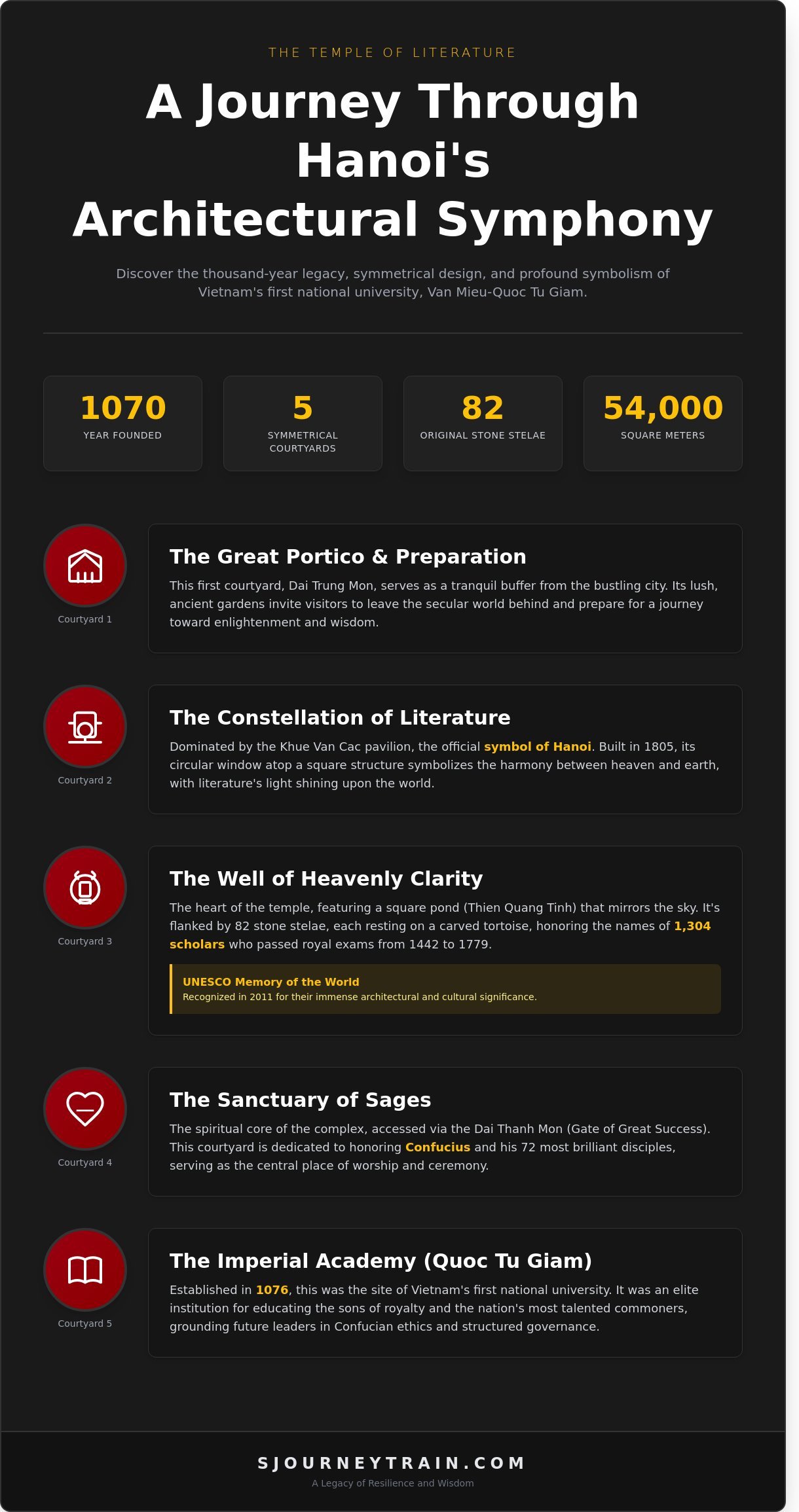
Walking through the gates of the temple of literature feels like stepping into a different dimension. The 54,000 square meter complex follows a strict, symmetrical axis that reflects the ancient belief in universal harmony. You leave the frantic hum of Hanoi’s motorbikes behind as you pass through the Great Portico. Each step forward is a metaphorical movement toward wisdom and clarity. The design doesn’t just house history; it guides you on a structured journey toward enlightenment.
The Outer Courtyards: Preparation and Peace
The first two courtyards serve as a necessary buffer between the secular world and the sacred. In the First Courtyard, known as Dai Trung Mon, you’ll find lush, manicured gardens that have offered shade for centuries. The Second Courtyard holds the Khue Van Cac pavilion. Built in 1805, this red wooden structure with its circular windows is the official symbol of Hanoi. It represents the "Constellation of Literature" shining its light on the earth. Take a moment to breathe here; the ancient banyan trees provide a canopy that predates much of the modern city’s skyline.
The Heart of the Temple: The Well of Heavenly Clarity
The Third Courtyard centers around the Thien Quang Tinh, or the Well of Heavenly Clarity. This square pool acts as a mirror for the sky, symbolizing the transparency required for deep study. Flanking the water are 82 stone stelae mounted on the backs of tortoises. These records honor the names of 1,304 doctors who passed royal exams between 1442 and 1779. Their architectural and cultural significance earned them a place on the UNESCO Memory of the World register in 2011. They serve as a permanent reminder of the power of human potential and academic resilience.
The Inner Sanctums: Worship and Learning
The Fourth Courtyard, accessed through the Dai Thanh Mon, is the spiritual core of the site. It’s where scholars once honored Confucius and his 72 most talented disciples. The final section is the Thai Hoc courtyard. This was the site of the Imperial Academy, Vietnam’s first university. While the original structures were destroyed in 1946, the current buildings were rebuilt in 2000 to honor the nation’s academic legacy. You’ll notice the Bell Tower and Drum Tower on either side of the grounds. These massive instruments once signaled the start and end of the scholars’ day, marking the rhythm of a life dedicated to growth.
If you’re ready to explore these historic grounds and unlock your own sense of wonder, you can book a journey from Hanoi to see how the past continues to shape the future of Vietnam.
Beyond the Stone: The Imperial Academy and Vietnam’s First University
The Imperial Academy, or Quoc Tu Giam, represents the heartbeat of intellectual pursuit within the temple of literature. Established in 1076, this institution served as the country’s first university for over 700 years. It wasn’t merely a school for the elite; it was a crucible for character. While it initially catered to royalty, the academy eventually opened its doors to gifted commoners. This shift marked a critical transformation in Vietnamese society by prioritizing merit over birthright. These scholars, known as Giam Sinh, lived a life of rigorous discipline. They spent years mastering the Five Classics and Four Books. Their journey wasn’t just about rote memorization. It was about developing the resilience needed to lead a nation. This human-centric approach to growth ensured that the most capable minds could unlock their potential to serve the public good.
The Power of the Royal Examinations
The path to success was paved with three grueling levels of testing. Candidates first faced the Huong (regional) exams, followed by the Hoi (national) level. The final hurdle was the Dinh exam, held within the royal palace itself. Success brought immense prestige. Since 1442, the names of these graduates were carved into stone stelae. These records are now recognized as a UNESCO Memory of the World, preserving the legacy of 1,304 doctoral laureates. Each stone sits atop a tortoise, a creature chosen to symbolize longevity and strength, signifying that true knowledge should endure for generations.
Confucian Values in Modern Vietnam
Walking through the temple of literature today, you feel the weight of "Ton su trong dao." This philosophy of respecting teachers remains a cornerstone of Vietnamese culture. Even in 2026, thousands of students flock here before finals to pray for success. They seek the same clarity and focus that guided ancient scholars. This dedication to learning mirrors the modern professional’s quest for excellence. It’s a reminder that your personal growth is an ongoing journey. When you visit Hanoi on a Hanoi to Hanoi tour, you witness how ancient wisdom still empowers modern leaders to thrive and navigate the complexities of the professional world. Understanding these deep-rooted values provides crucial insight into Vietnamese people and their cultural heritage, which continues to shape the nation’s approach to education, respect, and social harmony.
Planning Your Visit: Expert Tips for a Sophisticated Experience
Your visit to the temple of literature should feel like a deliberate pause in Hanoi’s energetic rhythm. It’s a chance to engage with a legacy of wisdom that spans nearly a millennium. To truly appreciate the site, you must navigate the environment with intention. Arriving at 8:00 AM allows you to witness the morning mist lifting off the ancient courtyards before the humidity climbs toward its typical 32°C peak. This early start ensures you stay ahead of the large tour groups that often arrive by 10:00 AM, preserving the quietude necessary for reflection.
Respect is the foundation of your experience here. This is a sacred space, not just a historical monument. You’ll need to wear attire that covers your shoulders and knees. Choosing breathable, high-quality fabrics like linen or silk will help you stay cool while honoring local customs. By 2026, the temple has fully integrated advanced 3D mapping technology for its evening tours. These displays use light to narrate the stories carved into the 82 Doctor’s Stelae, transforming cold stone into a vivid tapestry of human achievement. It’s a powerful way to see how technology can unlock the potential of the past.
Timing and Etiquette for the Discerning Traveller
Timing your arrival is vital for both comfort and atmosphere. The 4:00 PM window is particularly special, as the golden hour light filters through the ancient trees, creating a serene environment for photography. Move through the five courtyards slowly. This isn’t a site to rush. If you’re managing a tight schedule, you can integrate this visit into a curated Hanoi to Hanoi luxury day tour. This approach allows you to balance the temple’s quietude with the city’s other heritage landmarks without the stress of logistics.
Photography and Hidden Details
To capture the iconic Khue Van Cac pavilion without the crowds, find an angle near the corner of the Thien Quang Well. The reflection of the red wooden structure in the water creates a symmetrical shot that highlights the architectural balance. Don’t forget to look up. The rooflines are adorned with intricate phoenix and dragon carvings that represent power and grace. The contrast between the weathered red lacquer of the gates and the vibrant green of the manicured gardens offers a perfect palette for high-end photography. Focus on these small, human-scale details to tell a deeper story of your journey through Vietnam’s intellectual heart.
Ready to explore the depths of Vietnamese heritage with expert guidance?
Book your curated Hanoi heritage experience today.
Continuing the Journey: From Ancient Spires to Luxury Rail
The temple of literature represents the first step in a deep, meaningful understanding of Vietnam. It’s where the pursuit of excellence began in 1070 AD, establishing a cultural bedrock that still supports the nation today. After walking through the five courtyards and studying the names of scholars etched in stone, you’ll feel the weight of history. This site isn’t just a monument; it’s the intellectual starting point for any traveler who wants to see beyond the surface of Hanoi. Once you’ve absorbed the quiet dignity of the scholars’ path, the natural progression is to witness how that legacy has evolved into the vibrant, modern energy of the south.
The Path from Hanoi to the South
A Hanoi to Ho Chi Minh City tour serves as the perfect extension of your cultural deep dive. Your transition from the ancient past to the contemporary future begins at Hanoi’s central station, a landmark that has stood since 1902. Departing from this historic hub after a day spent at the temple of literature allows you to carry the spirit of the scholars with you. The journey south is a physical manifestation of Vietnam’s growth, moving from the traditional roots of the capital toward the economic pulse of Ho Chi Minh City.
This route covers over 1,700 kilometers of diverse landscapes, offering a perspective that flying simply cannot provide. You’ll see the 11th-century values of education and perseverance reflected in the hardworking communities and changing vistas outside your window. It’s a rhythmic, intentional way to travel that mirrors the steady progress of the scholars who once walked Hanoi’s hallowed halls. As you journey south, you’ll discover how Vietnam’s history of resilience extends beyond academic pursuits to include remarkable feats of strategic ingenuity, such as the Cu Chi tunnels in Saigon, where underground networks tell another chapter of Vietnamese determination and innovation. This journey also provides an opportunity to observe the diverse regional characteristics and traditions that define Vietnamese people across different provinces, from the scholarly traditions of the north to the entrepreneurial spirit of the south.
Elevated Experiences Onboard
Ancient scholars spent decades mastering the human skills required to lead with integrity. We believe those same values of resilience and wisdom should define your modern travel experience. At SJourney, we’ve replaced the rigid desks of the past with exceptional service and facilities that prioritize your personal well-being. This isn’t just transportation; it’s a space for transformation. We provide a sanctuary where you can process your discoveries in total comfort.
You can reflect on Vietnam’s complex history while enjoying curated food and beverages in our lounge car, turning every mile into a moment of insight. Our team acts as your visionary mentor, ensuring every detail of your trip is handled with authoritative expertise and warm accessibility. If you’re ready to see the country through a more sophisticated lens, we encourage you to book a bespoke heritage experience today. Your journey is just beginning.
Step Into Your Own Story of Discovery
Walking through the five courtyards of the temple of literature offers more than a simple history lesson. It’s an encounter with a legacy dating back to 1070. You’ve discovered how the 82 stone stelae honor centuries of academic excellence and navigated the architectural symmetry of Vietnam’s first university. These hallowed grounds represent a thousand years of intellectual pursuit that still resonates in Hanoi’s modern rhythm. Transitioning from these ancient stone paths to a contemporary exploration requires a partner who understands the value of deep cultural immersion. SJourney provides this bridge through bespoke heritage itineraries and expert-led cultural excursions that bring history to life. After a day of discovery, you’ll retreat to luxury cabin accommodations that offer a sanctuary as peaceful as the Khue Van Cac pavilion itself. Every step of your trip should feel like a meaningful progression toward a deeper understanding of this vibrant land. For those seeking to explore travel opportunities that prioritize authentic cultural encounters over tourist traps, we’re ready to help you navigate this transformation with grace and sophistication.
Begin your cultural journey through Vietnam with SJourney
Frequently Asked Questions
What is the best time of year to visit the Temple of Literature in Hanoi?
The best time to visit the temple of literature is between October and December when temperatures stay between 15 and 25 degrees Celsius. These autumn months provide the most comfortable atmosphere for your personal journey through Hanoi’s history. You’ll avoid the 90 percent increase in foot traffic typically seen during the Lunar New Year in late January or February. Early mornings at 8:00 AM allow you to experience the grounds before the heat peaks at midday.
Is there an entrance fee for the Temple of Literature in 2026?
The entrance fee for the Temple of Literature in 2026 is 70,000 Vietnamese Dong for adults, which is approximately 2.80 US dollars. Students with a valid ID card receive a 50 percent discount, bringing their cost down to 35,000 Dong. You can purchase your tickets at the main entrance gate using cash or digital payment methods. This small investment unlocks access to one of Vietnam’s most resilient cultural landmarks and supports its ongoing preservation.
How long does it take to fully explore the five courtyards?
You should set aside 60 to 90 minutes to fully explore the five courtyards and appreciate the architectural transformation of the site. This timeframe allows you to read the inscriptions on the 82 stone stelae and observe the intricate carvings in the House of Ceremonies. If you’re a photography enthusiast, you might spend an extra 20 minutes capturing the symmetry of the Khue Van Cac pavilion. Navigating the grounds at this pace ensures a meaningful experience on your journey through the city.
Can you take photos inside the Temple of Literature?
You’re welcome to take photos throughout most of the temple grounds, including the picturesque gardens and the Well of Heavenly Clarity. However, photography is strictly prohibited inside the inner sanctums and altar areas where 100 percent of visitors are expected to show quiet respect. You’ll find that the natural lighting is best before 10:00 AM for capturing the red lacquer details. Please ensure your camera equipment doesn’t block the narrow stone pathways for other visitors.
What should I wear when visiting the Temple of Literature?
You must wear modest clothing that covers both your shoulders and knees to respect the spiritual nature of the temple of literature. This dress code is a mandatory requirement for 100 percent of visitors entering the historic gates. Choose breathable fabrics like linen or cotton to stay comfortable while you navigate the outdoor spaces. If you’re wearing a tank top, carrying a light scarf is a practical way to ensure you’re prepared for entry without any delays.
Is the Temple of Literature accessible for travellers with limited mobility?
The site is partially accessible, with approximately 60 percent of the ground-level courtyards reachable via paved stone paths. While the main areas are flat, you’ll encounter small stone thresholds and 3 to 5 steps between some of the historic sections. Travellers with limited mobility can still enjoy the primary gardens and the view of the central pavilion. We recommend visiting with a companion who can assist you in navigating the uneven surfaces of the ancient walkways.
Are there guided tours available at the site?
You can hire professional on-site guides at the ticket counter or use the electronic audio guides available in 12 different languages. These resources help you unlock the deep history of the 82 doctor stelae and the site’s role as Vietnam’s first university. A guided session typically lasts 45 minutes and provides specific insights into the 1,000 year evolution of the grounds. Investing in a guide empowers you to understand the cultural impact of this historic landmark.
How far is the Temple of Literature from the Hanoi Old Quarter?
The Temple of Literature is located approximately 2.5 kilometers west of the Hanoi Old Quarter’s central Hoan Kiem Lake. A taxi or ride-share trip takes between 10 and 15 minutes depending on the city’s traffic flow. If you prefer to walk, the journey takes about 25 minutes through the bustling streets of the Ba Dinh District. This proximity makes it easy to integrate a visit into your daily itinerary while exploring the city’s core landmarks.